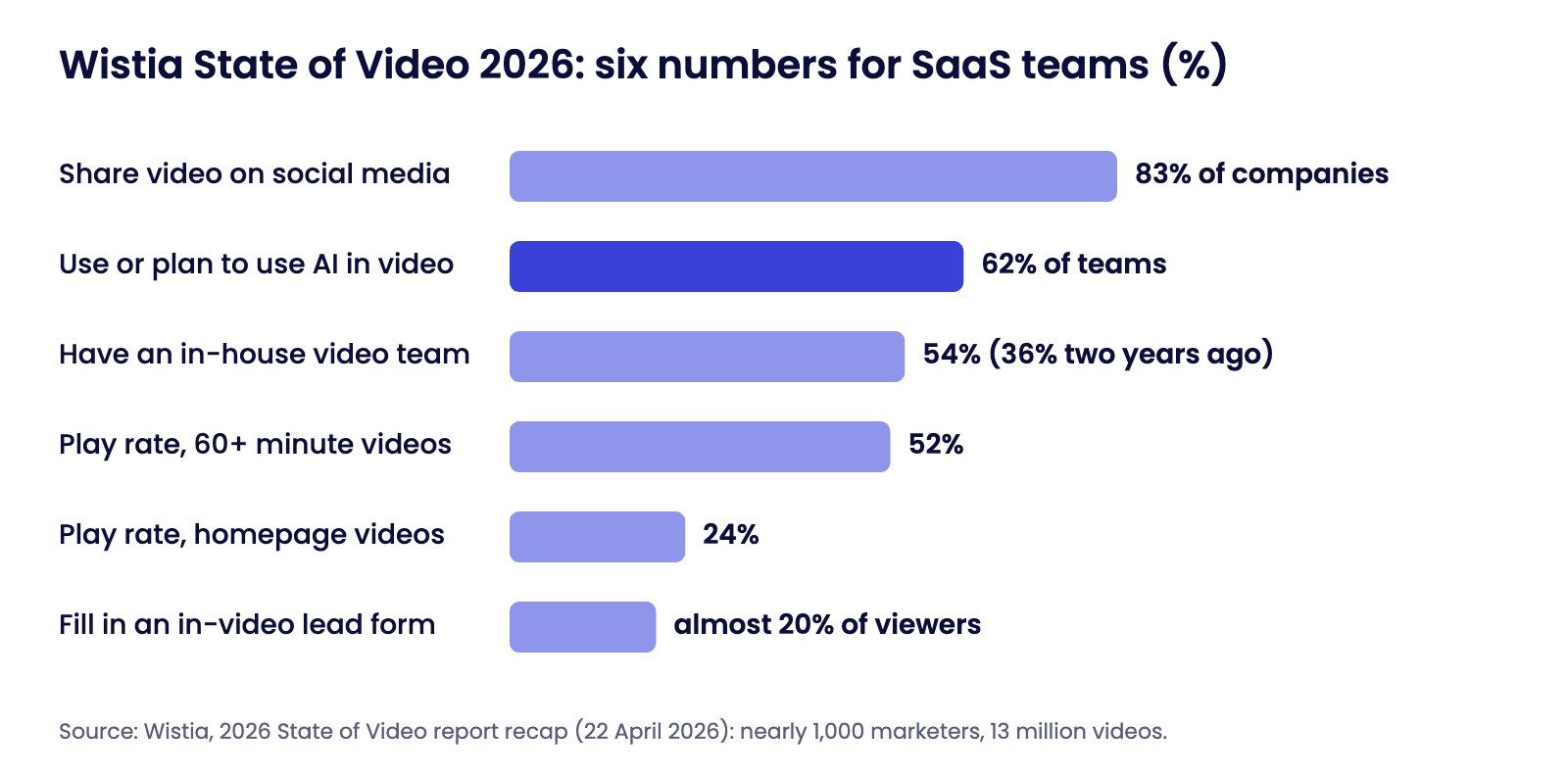
Quick answer: The clearest B2B video trends for 2026 come from Wistia’s State of Video report, based on a survey of nearly 1,000 marketers and more than 13 million videos.
- In-house video teams have grown from 36 percent of companies to 54 percent in two years.
- 62 percent of teams use AI in their video workflow or plan to, mostly for scripting and post-production rather than generating whole videos.
- 83 percent of companies share video on social media, with LinkedIn now the leading channel for B2B video.
- And website video still gives the best return: homepage videos see a 24 percent play rate, and almost 20 percent of viewers who see a lead form inside a video fill it in.
- For SaaS teams the practical reading is: put one strong video on the homepage, cut it down for LinkedIn, use AI to speed up the work around the video, and keep a human in charge of the script and the voice.
Disclosure: this guide is published by Motion Graphix, an explainer video studio that is mentioned in it. The method, sources and definitions are in “About this guide” at the end of the article.
Key takeaways
- More companies make video in-house (54 percent, up from 36 percent), so the bar for everyday content is rising. Outside studios are now hired for the videos that have to be right: the homepage explainer, the product demo, the launch.
- AI is used around the video, not instead of it. Wistia’s own production lead lists scripting, fixing voice-over lines, music and audio clean-up. AI voice-overs tend to underperform human voices.
- Social gets attention and the website gets action. LinkedIn is the top B2B channel, but the homepage is where video has the highest play rate.
- One production should yield many cuts. With 83 percent of companies sharing video on social media, every flagship video needs versions for the feed as well as the website.
The six numbers that matter
| Finding | Figure | What it means for a SaaS team |
|---|---|---|
| Companies with an in-house video team | 54%, up from 36% in two years | Routine video moves in-house; specialists are hired for flagship pieces |
| Teams using AI in video workflows, or planning to | 62% | Use AI for scripts, edits and audio; keep people on story and voice |
| Companies sharing video on social media | 83%, LinkedIn the top B2B channel | Every video needs vertical and square cuts for the feed |
| Teams naming social engagement as a success metric | 22%, up from 12% in a year | Views are no longer enough; measure reactions, comments and replies |
| Play rate of homepage videos | 24%, higher than product, contact and thank-you pages | The homepage is the first place to put an explainer |
| Viewers who complete a lead form shown inside a video | Almost 20% | Gate the demo, not the explainer |
Trend 1: video is moving in-house, and that changes what you outsource
Wistia reports that the share of companies with an in-house video team rose from 36 percent to 54 percent in two years, and that marketers, content strategists and subject experts are now making videos themselves. For a SaaS company this is good news for volume: weekly product updates, webinar clips and support videos no longer need a vendor.
It also raises expectations. When every competitor publishes regular video, the pieces that represent the product (the homepage explainer, the main demo, the launch film) carry more weight, and those are the ones worth a specialist.
The trade-offs are set out in explainer video agency vs freelancer and Loom vs professional demo video.
Trend 2: AI speeds up the work around the video
62 percent of teams use AI in video or plan to, and more than half plan to spend more on it this year. The report is specific about where it helps: brainstorming, planning, scripting and post-production.
Wistia’s head of production names four everyday uses: drafting scripts, repairing a voice-over line without recalling the voice artist, generating background music and cleaning up audio. The same report adds a caution that matters for product videos: AI voice-overs tend to underperform human voices, with the gap narrowing when the script and pacing are strong.
A fuller comparison is in AI video generator vs studio and AI avatar videos for SaaS.
Trend 3: LinkedIn is the leading B2B video channel
83 percent of companies now share video on social media, and Wistia identifies LinkedIn as the number one channel for B2B video. The share of teams that treat social engagement as a top success metric nearly doubled in a year, from 12 to 22 percent.
For a SaaS founder that points to a simple routine: one produced video per month, cut into several short clips, posted from a personal profile with a line of context. The format and cadence are covered in LinkedIn video for SaaS and founder-led video for SaaS.
Trend 4: the website is still where video pays back
Social video earns attention; website video earns action. Homepage videos have a 24 percent play rate, the highest of any page type Wistia measured, and almost one in five viewers who are shown a lead form inside a video complete it.
Long videos belong on the site too: videos of 60 minutes or more have a 52 percent play rate. In practice, lead with a 60 to 90 second explainer near the top of the homepage, place a demo on each product page, and keep webinars and long walkthroughs in a resources section. Length guidance is in explainer video length.
Trend 5: webinars are an asset, not an event
Three in four companies host webinars, and on-demand replays keep attracting views six months after the live date. Replays longer than 30 minutes saw twice the engagement of shorter ones, and 88 percent of teams repurpose webinar content, most often as landing-page replays and social clips.
A product team can treat each webinar as raw material for a month of short videos. See how to repurpose explainer video assets.
What to do with this in the next quarter
- Audit the homepage. If there is no video above the fold, that is the first gap to close; it is the page with the highest play rate.
- Plan cuts before production. Ask for 16:9, 9:16 and 1:1 versions and two or three short clips from the same project.
- Use AI where it saves time. Drafting, transcription, captions and audio repair. Keep a person on the script and use a human voice for buyer-facing videos.
- Measure beyond views. Play rate on the page, completion, form fills and replies on social.
- Split the work. Routine video in-house; flagship video with a studio.
Related guides: explainer video trends 2026, SaaS video marketing statistics, SaaS video production, SaaS explainer video cost and best SaaS explainer video companies.
Related strategy guides: video ads for SaaS, video SEO for SaaS, SaaS product launch video strategy, SaaS customer testimonial videos, video production subscriptions compared, SaaS onboarding videos.
Quick questions
What are the main B2B video trends in 2026?
More in-house production (54 percent of companies have a video team), AI used for scripting and post-production (62 percent of teams use it or plan to), LinkedIn as the leading B2B video channel, and website video delivering the best return, with a 24 percent play rate on homepages. Source: Wistia’s 2026 State of Video report.
Is AI replacing video production teams?
No. According to Wistia’s 2026 report, most teams use AI to brainstorm, plan, script and speed up post-production, and the creative work remains with people. AI voice-overs tend to underperform human voices.
Where should a SaaS company put its explainer video?
On the homepage first. Wistia’s data shows homepage videos have a 24 percent play rate, higher than product pages, contact pages and thank-you pages.
Which social channel works best for B2B video?
LinkedIn. Wistia’s 2026 report names it the number one channel for B2B video, with 83 percent of companies sharing video on social media.
Should B2B companies still outsource video in 2026?
For flagship videos, yes. As routine video moves in-house, the homepage explainer, the main product demo and launch videos are the pieces where a specialist’s script, design and animation make the difference.
About this guide
Where the figures come from. Every statistic in this article is taken from Wistia’s published recap of its 2026 State of Video report (22 April 2026), which draws on a survey of nearly 1,000 marketers and an analysis of more than 13 million videos hosted on Wistia. The interpretation for SaaS teams is ours.
Who publishes this
- Motion Graphix is a London-registered explainer and product demo video studio founded in 2022 by Zahid Nawaz.
- It makes SaaS explainer videos and app demo videos at a published price of $1,450 per video, listed on its pricing page.
- Corrections are welcome at the contact page.
Terms used in this article
- Play rate: the share of people who load a page with a video and press play.
- In-house video team: employees who plan, shoot or edit video as part of their role, as opposed to an outside studio or freelancer.
- Cutdowns: shorter edits of a main video in vertical (9:16) and square (1:1) formats for social feeds.
- Lead form: a short form shown inside the video player that collects a viewer’s contact details.
Sources and further reading
- Wistia: The Key Takeaways From Wistia’s 2026 State of Video Webinar (22 April 2026).
- Wistia: 2026 State of Video report, the full report.
- Wyzowl: Video Marketing Statistics, the annual survey on video adoption.