By Zahid Nawaz, Founder of Motion Graphix ·
Quick answer: An explainer video sells the problem and the promise; a demo video proves the product delivers it. Explainers answer “why should I care?” in 60 to 90 seconds of story. Demos answer “how does it work?” by walking a real task through real screens in 60 seconds to four minutes. Early-stage buyers need the explainer, comparison-stage buyers need the demo, and most SaaS companies end up needing both, cut from one production. Below is a placement-by-placement guide, the symptoms that tell you which one you are missing, the hybrid that works for simple products, and what each costs.
The difference in one table
| Explainer video | Demo video | |
|---|---|---|
| Question it answers | Why should I care? | How does it work? |
| Viewer | Does not yet know the problem has a solution | Is comparing solutions |
| Length | 60 to 90 seconds | 60 to 120 seconds for marketing, two to four minutes for sales |
| Visual approach | Story, metaphor, the buyer’s world, then the product | The real interface, one workflow, start to finish |
| Ends on | The promise and a call to action | The finished result and a call to action |
| Lifespan | A year or more | Until the UI changes (keep the source files) |
| Example | Wonderkind, ZenBusiness, Picnic | Fyxer in Gmail, Genie 3.0, JobAdder Analytics |
What an explainer does that a demo cannot
An explainer makes someone care about a problem they had stopped noticing. ZenBusiness’s video names the feeling that starting a company is exciting for about a day and then it is forms, before the platform appears as relief. Picnic frames office lunch as an operations problem disguised as a perk. Neither shows a workflow; both make the viewer want one. A demo cannot do this, because a demo assumes the viewer already wants to see how.
What a demo does that an explainer cannot
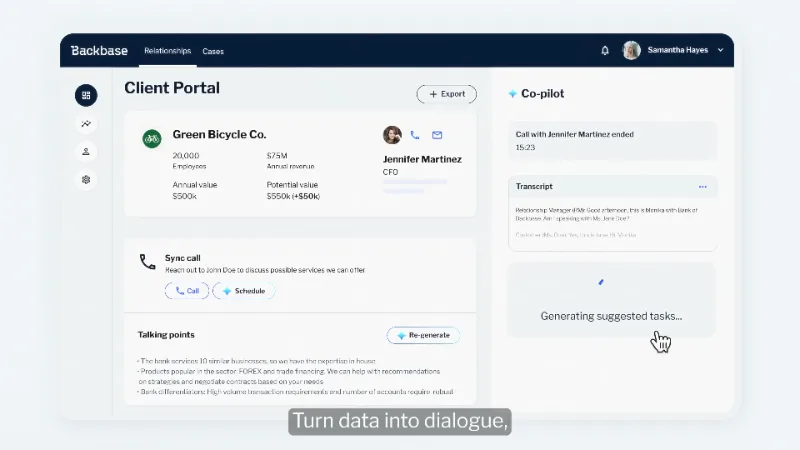
A demo removes the last doubt. Fyxer’s video sits inside a normal Gmail window while the assistant sorts, labels and drafts, and stops just before the send button. Genie 3.0 drops two signed contracts in and lets the review, the extraction and the comparison unfold in order. A buyer who has watched that does not need to book a call to believe the product works. An explainer cannot do this, because the moment it stops to show a real workflow it stops being a story. Twelve demo examples show the pattern.
Which one each placement needs
- Cold ads and social: explainer. The audience does not know the problem has a solution yet.
- Homepage hero: explainer for broad audiences; demo if visitors arrive already comparing tools (branded search, review-site traffic, developer tools).
- Feature and solution pages: demo, one per feature or use case.
- Pricing and signup pages: demo. Remove the last doubts with proof.
- Sales outreach and follow-ups: demo, so the champion can resell you internally. See demo videos for sales teams.
- Onboarding and help centre: demo walkthroughs, step by step.
- Launch day and Product Hunt: a short explainer-shaped launch video; the launch strategy covers it.
- App store: a 15 to 30 second demo, because the store rules forbid anything that is not the app.
How to tell you picked the wrong one
- High traffic, visitors bounce before scrolling. Your demo is answering a question nobody asked yet. You need an explainer above it.
- Lots of video views, no trials or demos booked. Your explainer excites but never proves. You need a demo on the next page down.
- Sales says prospects “get it” on the call but not before. You have an explainer and no demo to send after the first conversation.
- Support asks the same how-do-I question weekly. You have a demo and no onboarding walkthroughs. See onboarding videos.
The hybrid, and when it works
For simple products with one obvious workflow, a 60 to 75 second explainer-demo works: 25 seconds of story that names the problem and the promise, 35 seconds of the real product doing the one thing, five seconds of result and call to action. Codient’s video is close to this shape: prospecting breaks the moment you leave LinkedIn to update a CRM, then the whole flow on one screen from profile to logged lead. Complex products should split them, because a hybrid that tries to prove three workflows proves none. Most of the best SaaS explainers are hybrids in this sense: story first, real UI second.
Why you should make both from one production
The two formats share research, the script’s core claim, the brand design system, the voice artist and the animation assets. Producing them together costs far less than producing them apart, and the viewer gets a consistent story from the first ad to the signup page. In practice, the explainer’s “proof” section is a compressed version of the demo, and the demo’s opening is a compressed version of the explainer. Our five-video bundle at $1,000 per video exists for exactly this: a homepage explainer, two or three feature demos and a launch cut, all in one style.
What each costs
At most studios a 60 to 90 second explainer and a 60 to 120 second demo are priced the same, $1,450 to $10,000 depending on who makes it; longer sales walkthroughs of two to four minutes cost more. At Motion Graphix either is a flat $1,450 including script, voice-over, all formats and 90 days of changes, with longer walkthroughs quoted after a call. Explainer video cost has the full comparison.
Quick questions
What is the difference between a demo video and an explainer video?
An explainer sells the problem and the promise in a 60 to 90 second story; a demo proves the product works by showing a real task on real screens. Explainers are for people deciding whether to care, demos for people deciding which tool.
Can one video do both jobs?
For a simple product with one obvious workflow, yes: about 25 seconds of story, 35 seconds of screens. Complex products should split them.
Which converts better?
Neither in isolation. Matching the video to the funnel stage is what moves conversion: explainer for cold traffic, demo for warm.
Which should we make first?
If your homepage has no video, the explainer. If sales is losing deals between the first and second call, the demo. If you can only afford one and buyers arrive from branded search, the demo.
Where do we start?
See SaaS explainer production and app demo production, read the complete demo video guide, or request a free sample and tell us which page it is for.