By Zahid Nawaz, Founder of Motion Graphix ·
Quick answer: Isometric animation is a 2.5D style that draws systems from a fixed three-quarter angle, so you can show several modules, data flows or locations on one screen without perspective distortion. It is the right choice when the product is a system rather than a screen: infrastructure, security, logistics, supply chains, multi-location operations. It is the wrong choice when the product is an app people actually use, because it hides the interface. Cost is the same as flat 2D at good studios ($1,450 at ours); the difference is time spent on illustration rather than on UI.
What isometric animation actually is
Isometric projection shows a scene from above and to the side at equal angles, with no vanishing point. Lines that are parallel in the real world stay parallel on screen, so a warehouse, a server rack and a delivery van can sit on the same grid and all read clearly. It is why the style became the default for cloud, cybersecurity and infrastructure companies: it can show a lot of information at once, in order, with depth but without the chaos of a moving 3D camera (source). Compared with full 3D, it is faster to produce, easier to revise and does not need rendering farms. Compared with flat 2D, it gives abstract systems a physical presence.
When isometric is the right call
- The product is invisible. Data pipelines, notification infrastructure, payment rails, network security. There is no screen to show, or the screen is a config page nobody wants to watch.
- The value is in the connections. An ERP talking to a warehouse talking to a helpdesk. Isometric lets the viewer see all three and the lines between them. Our Swap video draws exactly those connections first, so the stockout it prevents actually means something.
- Several locations or steps happen at once. A supply chain, a multi-site deployment, a fleet. Isometric handles simultaneity better than any other 2D style.
- The audience is technical and distrusts gloss. Isometric reads as a diagram that moves, which engineers and operations buyers find credible.
When it is the wrong call
- The product is an app. If buyers will judge the interface, show the interface. Isometric buildings with tiny screens inside them hide your best evidence. Use a UI-led demo instead.
- The story is about a person. Isometric characters are small and faceless by design. Emotional stories need close-ups, which means character animation or live action.
- You want it to look unlike your competitors. Isometric has been the house style of cloud and security companies for a decade. It is safe, which is a different thing from distinctive.
- Your brand is warm and consumer-facing. The grid can feel cold. Phantom’s video, for a crypto wallet aimed at people who are not on chain yet, used stickers and gradients for exactly this reason.
What it costs and why
Isometric is often quoted higher than flat 2D because every object has to be drawn in projection, and a scene with a dozen objects is a dozen illustrations. At studios with a mature library and a consistent pipeline, the difference disappears; we charge the same $1,450 flat price for isometric as for any 2D style. Freelance quotes typically run $1,500 to $5,000 and agency quotes $8,000 to $25,000 for a 60 to 90 second isometric piece. Timelines quoted elsewhere of eight to twelve weeks are an agency habit, not a technical requirement; our first draft arrives in 10 to 15 working days regardless of style. For context on the full market, see explainer video cost.
How to brief an isometric video
- List the entities. Every system, location, device and actor that appears. If the list is longer than eight, the video is trying to show too much.
- Draw the flow on paper. What moves from where to where, in what order. The animation is this diagram with time added.
- Decide where the camera lives. Isometric works because the angle is fixed. Resist the urge to swoop.
- Pick one moment to break the style. A cut to the real UI, a close-up on a person, a flat typographic card with the key number. The contrast makes both halves stronger.
- Write the script first. Isometric scenes are expensive to re-illustrate after animation starts, so lock the words before the drawings. Our storyboard guide explains the stage where this gets caught.
Isometric versus the alternatives
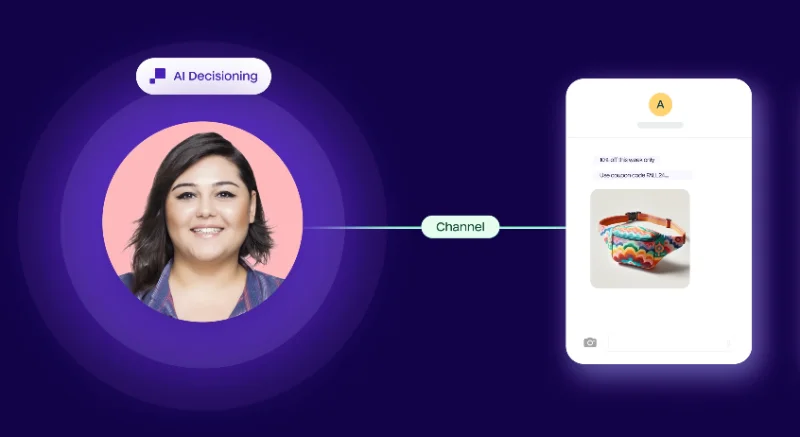
Flat 2D is faster, friendlier and better for products with a visible interface. Full 3D gives photoreal depth at two to three times the cost and is rarely justified for software. Mixed media (isometric for the system, real UI for the product, a presenter for trust) is what most of our infrastructure clients end up with, and it is covered in explainer video styles compared. HighTouch’s video is a useful reference: a wall of customer avatars, then a different path for each one, which makes the case for decisioning faster than a diagram of your data warehouse would, without a single isometric server in sight. Style should follow the argument, not the industry’s habit.
Quick questions
Is isometric animation 2D or 3D?
Technically 2D drawn to look three-dimensional, often called 2.5D. It is produced in 2D tools and does not need 3D rendering.
How much does an isometric explainer video cost?
$1,500 to $25,000 depending on who makes it. Ours is $1,450 with script, voice-over, social cuts and source files included.
How long does it take?
First draft in 10 to 15 working days at our studio. Agencies commonly quote eight to twelve weeks.
Can we mix isometric with our real product screens?
Yes, and you usually should. Use isometric for the system view and cut to the real UI for the moment the product does its job.